The Private Label Perfume Brief: What to Settle Before Sourcing
Most private label perfume projects do not fail at the perfumery stage. They fail because nobody wrote down what the finished product has to be before suppliers were asked to quote. A brief that fixes the format, the wear target, the market, the packaging route and the compliance position turns a vague conversation into comparable quotes. Without it, every supplier prices a different product.
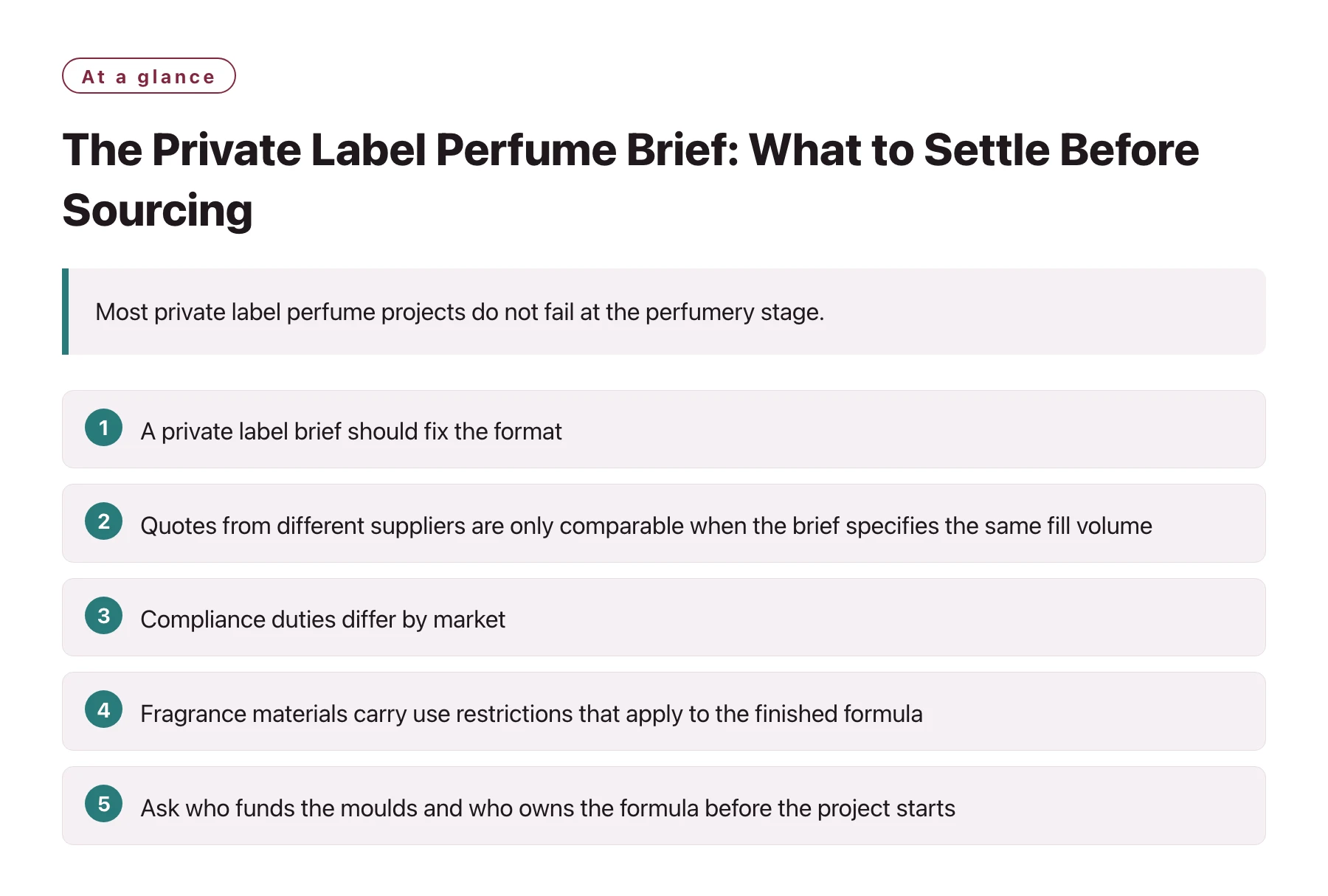
Key takeawaysA private label brief should fix the format, wear target, market and packaging route before any sampling starts. · Quotes from different suppliers are only comparable when the brief specifies the same fill volume, packaging scope and testing requirements. · Compliance duties differ by market, and the European Union expects a responsible person and a product information file before a cosmetic is placed on the market. · Fragrance materials carry use restrictions that apply to the finished formula, so restricted-material headroom belongs in the brief. · Ask who funds the moulds and who owns the formula before the project starts, not after the first order ships.
Why do two private label quotes for the same product arrive thousands of dollars apart? Usually because the two suppliers are quoting different products. One has priced a fragrance oil in a stock bottle with a stock cap. The other has priced a custom bottle, a custom cap, a printed carton and a full stability test programme.
The remedy is not a longer brief for its own sake. It is a brief that makes the scope identical across every supplier you approach, so that price differences reflect capability and overhead rather than assumptions.
The checklist below is structured in the order a private label project usually encounters these decisions. Working through it takes an afternoon and typically removes one or two sample rounds from the schedule.
Decide the commercial frame first
Before any technical detail, settle the numbers that constrain everything else: target retail price, target unit cost, first order quantity and the launch date. These four values determine the fill size, the packaging materials that are realistic, and how much development time can be absorbed.
Buyers sometimes hold these back to preserve negotiating room. In practice it slows the project down, because a supplier who does not know the cost ceiling will propose a formula the brand cannot sell at the intended price.
Fix the fill size and the format
Fill volume interacts with everything: the bottle weight, the cap, the carton, the unit cost and the perceived value. A 30 ml and a 50 ml version of the same scent are two different briefs, even if the juice is identical.
Decide also whether the range includes a travel size, a rollerball or a refill. Adding a second format later means new tooling and a new fill line setup, which is the most common source of unexpected cost.
Name the markets you will actually sell in
Markets determine labelling language, ingredient declarations, allergen statements and packaging obligations. Selling into the European Union brings specific duties, including a responsible person established in the Union and documentation that must be available to authorities [1].
List the markets in priority order. A brief that starts with one or two launch markets is easier to satisfy than one that asks for global compliance in the first order, and the second order can always expand the list.
The nine-point brief to use before requesting quotes
- Product category and formatFine fragrance, body mist, hair mist or home scent, with fill volume and container type stated explicitly.
- Wear target and intensityWhen the scent should be noticeable and for how long. This replaces the vague request for a strong formula.
- Reference directionTwo or three reference fragrances plus a short description of what you like about each, rather than note lists alone.
- Packaging scopeState whether bottles, caps, pumps, cartons and labels are in scope, and who is supplying the artwork.
- Cost and quantityTarget unit cost, first order quantity and expected annual volume. Volume expectations change the tooling conversation.
- Markets and labellingCountries of sale, required languages, and whether claims about ingredients or performance will appear on the pack.
- Compliance and testingWhich safety assessment, stability testing and third-party testing you expect, and who holds the documentation [2].
- Restricted materialsWhether the formulation must avoid specific materials for regulatory or brand reasons, checked against published standards [3].
- IP and tooling ownershipWho owns the formula, the moulds and the artwork, and what happens to each if the relationship ends.
The most expensive sentence in private label sourcing is a variant of we will sort the packaging out later. Packaging usually carries more of the unit cost than the fragrance compound and takes longer to produce than the juice, so a project that starts sampling before the bottle decision is made is scheduling its own delay. Bring a shortlist of two or three container options to the first technical meeting, even if they are stock items. It gives the supplier a real fill line to plan around and prevents a formula being tuned to a format that later becomes unavailable.
What a brief without these details costs you
| Missing detail | What the supplier assumes | What it costs later |
|---|---|---|
| No fill size | A mid-range volume that suits their standard line | Repricing, new tooling and a new stability cycle |
| No wear target | A middle concentration that samples well on paper | Reformulation after the first market feedback |
| No market list | Domestic labelling only | Redesigned artwork, re-testing and delayed launch |
| No packaging scope | Fragrance fill only, packaging quoted separately | Two suppliers to coordinate and no single point of accountability |
| No IP position | Formula treated as supplier property | No ability to move production without starting over |
| No testing expectation | Minimum internal checks only | Extra third-party testing on the critical path before launch |
Every row in this table is a question a supplier will ask anyway. Answering it up front converts a negotiation into a specification, and a specification is what allows you to compare a workshop, a mid-sized manufacturer and a large exporter on the same terms.
Turning the brief into a supplier decision
With the brief written, supplier selection becomes an evidence exercise rather than a chemistry of personalities. You are checking whether each candidate can document what they claim, and whether their answers stay consistent when you ask the same question twice.
This is the stage where a well-prepared buyer usually narrows a long list to two or three candidates quickly. The remaining differences are about service model, minimum order quantities and how the factory handles problems, not about whether they can make perfume.
Test the answers, not the brochure
Ask the same three technical questions of every candidate: how restricted materials are tracked, how a bulk batch is checked against the approved reference, and what happens when a packaging component arrives out of specification. The quality of those answers separates serious manufacturers from trading companies.
Ask for documentation in writing. Certificates and test reports should be straightforward to share with a prospective customer.
Check the compliance chain end to end
Compliance is not one document. It runs from the safety assessment of the formula through labelling and packaging obligations to the paperwork the importer must hold. Packaging rules in particular are moving, with extended producer responsibility and design requirements shaping what materials brands can use [4].
A supplier who understands where their responsibility ends and yours begins saves months of confusion later.
Work with a factory that can hold the whole scope
Every handover between suppliers is a place where information and accountability get lost. A manufacturer that develops the fragrance, sources the bottle and fills the finished product removes most of those handovers, and that is the model most private label programmes eventually settle into.
Suppliers such as Xuelei operate as a private label partner covering fragrance development, bottle and packaging design and filling, which is the arrangement most brands are looking for when they search for a private label perfume manufacturer in China. What matters in the end is not the label on the service but whether the brief above comes back as a product that matches it.
Sources
- European Commission: Cosmetics in the EU —— The European Commission's overview of EU cosmetics rules, including the responsible person, product information file and safety report requirements.
- SGS: Cosmetics, Personal Care & Household Testing —— Testing, inspection and certification services for cosmetics and personal care, including microbiological, stability and safety testing aligned with cosmetics GMP.
- IFRA Standards Library (International Fragrance Association) —— The IFRA Standards Library lists the restrictions the fragrance industry applies to individual fragrance ingredients, based on safety assessments; it is the reference point for compliant fragrance formulation.
- European Commission: Packaging Waste and the PPWR —— EU rules on packaging and packaging waste, including the Packaging and Packaging Waste Regulation requirements on recyclability and design.
Frequently asked questions
What is the minimum order quantity for private label perfume?
It depends on the packaging. Bottles and caps made from existing moulds allow much smaller first orders than fully custom tooling, where the mould cost has to be recovered. Ask for the MOQ per component, not just for the finished product, so the real constraint is visible.
Who owns the formula in a private label arrangement?
That is a contract question and should be settled in writing before development begins. Some suppliers retain formula ownership and license the product, others transfer it on payment of a development fee. Whichever route you choose, get the answer in writing and keep a copy of the approved formula reference.
Do I need my own brand registration before ordering?
For the packaging artwork, yes in practice. Trademark position varies by market and takes time, so the artwork and label review should run in parallel with development rather than after it. Your supplier can fill and pack to your artwork, but the brand rights remain your responsibility.
How long does a first private label order usually take?
The schedule is normally driven by packaging rather than by the fragrance. Sampling, selection and stability checks on the juice are relatively quick compared with custom bottle and cap production. Ask each supplier to give you the timeline by stage so you can see which part is on the critical path.
Should the first order use stock packaging?
Stock packaging shortens the lead time and reduces upfront cost, which makes it a sensible choice for a first order or a market test. Custom tooling becomes easier to justify once volume is predictable and the design has been validated in the market.