How Do custom hydraulic hoses Support Private Label and OEM Projects?
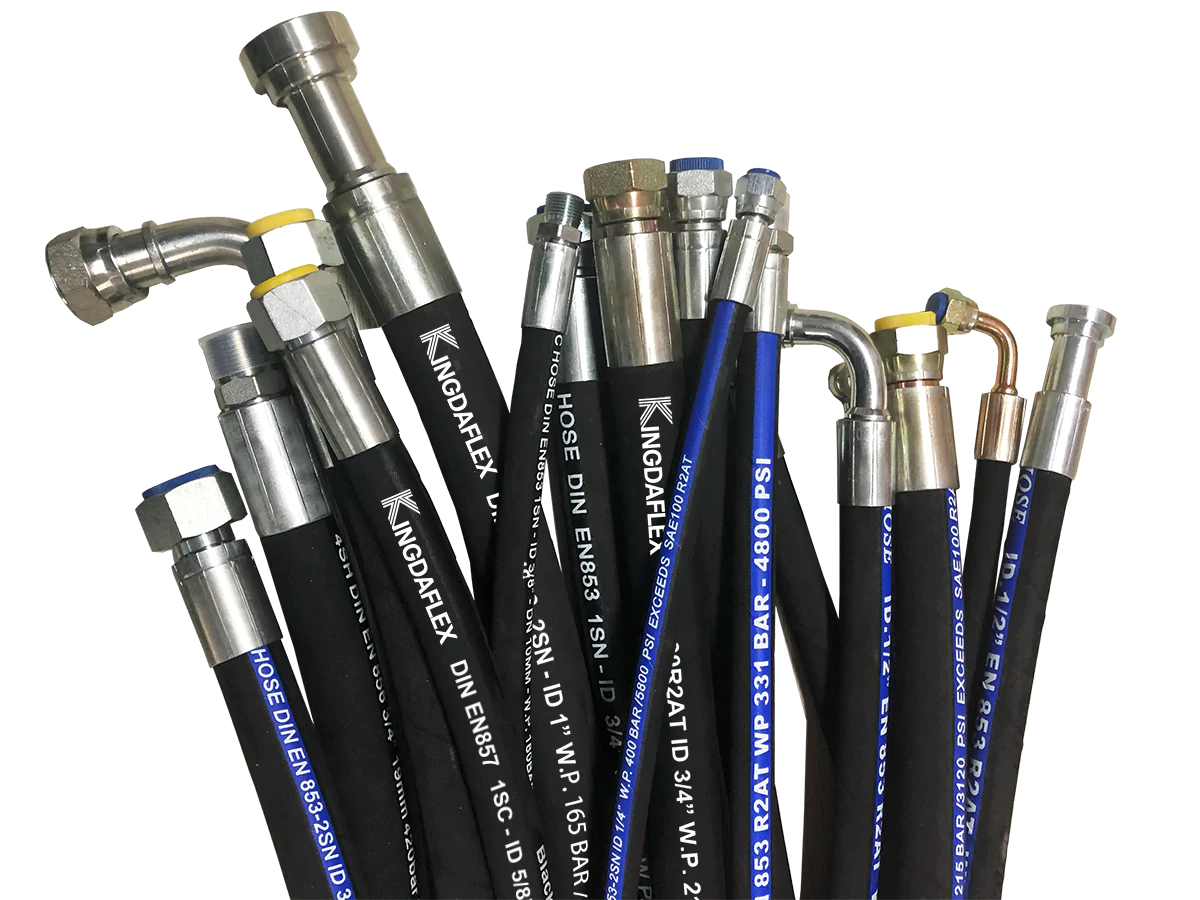
Custom hydraulic hoses support private-label and OEM programs by turning an approved hose, fitting, length, orientation, test, label, and packaging specification into a repeatable assembly. ISO 18752:2025 covers hydraulic hose sizes from nominal 5 to 102 and separates products into 10 pressure classes, 4 grades, and 7 types. OEM buyers can combine those hose requirements with JIC, ORFS, BSP, NPT, SAE, or metric ends, individual part numbers, sleeves, branded labels, kits, and batch records. The supplier is not only making hose assemblies; it is reproducing one controlled configuration across prototypes, production orders, and replacement-part orders.
An OEM hose specification normally starts with more information than hose ID and working pressure. Engineers also need overall assembly length, fitting type at both ends, fitting angle, angular orientation between bent fittings, minimum bend radius, fluid type, temperature, external abrasion exposure, and installation movement. A 90° elbow installed even several degrees away from the required position can make a short assembly difficult to route without twisting it. Private-label programs add customer part numbers, barcodes, carton quantities, label position, and packaging rules to the same production record.
That level of detail matters because hydraulic hose performance is limited by the complete assembly, not the rubber hose alone. ISO 18752:2025, published in June 2025, specifies 10 pressure classes and seven hose types, while connection ends remain outside the scope of that standard. A manufacturer therefore has to confirm the compatibility of hose, coupling, crimp specification, and end connection separately rather than treating an ISO-compliant hose as automatic approval of every possible fitting combination.
A useful OEM drawing identifies the hose, both end connections, assembly length, orientation, protective parts, marking, test requirement, revision level, and customer part number on one controlled record.
Pressure selection can show why component matching matters. Gates lists a 1/2-inch 4XP spiral-wire hose at 6,150 psi working pressure and 24,600 psi burst pressure, a 4:1 relationship in that published specification. Its 5/8-inch version is listed at 5,800 psi working pressure and 23,200 psi burst pressure. An OEM cannot assume the smaller hose specification applies after changing size, coupling family, or assembly construction; the approved hose-and-fitting system has to match the production drawing.
Temperature has the same effect on specification control. ISO 18752:2025 lists oil-based hydraulic-fluid service from -40°C to +100°C for AS, AC, BS, and BC types and up to +120°C for CS, CC, and DC types. Parker's published ranges also vary by product: several hydraulic hoses are rated to +125°C, while other constructions are limited to +100°C. A private-label catalog that prints one temperature rating across several different hose constructions can therefore create a specification problem before the product reaches a machine.
OEM development usually works better when one approved assembly becomes the production reference. The first batch may contain 10, 20, or 50 samples depending on project size; those quantities are commercial choices, not universal engineering standards. Each sample can be checked against the drawing for cut length, fitting orientation, thread, crimp diameter, sleeve position, marking, and packaging before larger releases. When the machine builder changes a 950 mm assembly to 1,015 mm, the supplier should issue a new revision rather than modifying shop-floor instructions without updating the controlled record.
A practical production file can contain:
-
Customer part number and supplier part number
-
Hose family, nominal ID, pressure rating, and applicable specification
-
End A and End B fitting codes, thread forms, and sealing styles
-
Overall length and permitted dimensional tolerance
-
Orientation for 45° or 90° fittings
-
Crimp diameter and approved tooling setup
-
Sleeve, spring guard, or abrasion protection requirements
-
Label text, barcode, lot number, and packaging quantity
-
Inspection frequency and required production records
Once that file is approved, repeat purchasing becomes much simpler. A customer ordering 500 assemblies does not need to send hose length, thread drawings, label artwork, and packing instructions again with every order. A purchase order can reference the approved part number and revision. For an OEM with 30 machines and 12 hose assemblies per machine, one production release represents 360 individually identified assemblies, so revision control becomes more useful as SKU count increases.
Branding adds another production layer. Private-label customers may request their logo on labels or packaging, a proprietary SKU, barcode, country-of-origin wording where applicable, carton labels, and replacement-part references. A supplier can apply 100% label verification as an agreed production requirement while pressure testing may follow a separate sampling plan or customer-specific procedure. The inspection plan should state what is checked on every assembly and what is sampled; “tested” without a stated method, frequency, or acceptance rule provides little information to an OEM quality team.
The same approach applies when an OEM sources hydraulic assemblies beside an industrial hose range. Hydraulic hoses may need high-pressure impulse performance, while other hose families can be selected for air, water, fuel, chemical transfer, material handling, or other media. Keeping part numbers, construction data, fluid compatibility, and service limits separate prevents a purchasing team from treating hoses with similar outside dimensions as interchangeable products.
Routing also deserves specification-level attention. Gates' 2025 hydraulic safety guide lists abrasion, operation above pressure requirements, bending below minimum radius, incorrect assembly length, and coupling-related conditions among causes to review when investigating premature hose problems. Its guidance recommends rerouting or adding protection where abrasion occurs and selecting a hose that meets or exceeds system maximum pressure. A supplier supporting OEM production can therefore add sleeves, spiral guards, or routing-specific fitting angles before the assembly is packed.
| Production item | Example OEM requirement | What the supplier controls |
|---|---|---|
| Hose | 1/2 in, specified pressure class | Correct hose lot and cut length |
| End A | JIC female swivel | Correct fitting and crimp |
| End B | 90° ORFS female | Angle and orientation |
| Length | 1,250 mm | Finished assembly measurement |
| Protection | Abrasion sleeve | Position and coverage |
| Identification | OEM PN 10482-B | Label, revision, lot |
| Packing | 10 assemblies/carton | Count and carton identification |
Traceability becomes useful when several batches of the same part number are in circulation. A label or internal record can associate an assembly with production date, hose lot, fitting lot, work order, inspection result, and customer revision. If 2,000 assemblies were supplied across four lots and a problem is reported from one production period, usable lot records allow the supplier and OEM to review the affected population rather than treating all 2,000 pieces as identical from an investigation standpoint.
Kitting extends the same control to the equipment assembly line. Instead of shipping 14 hose part numbers in separate bulk cartons, a supplier can package the 14 assemblies required for one machine, one hydraulic module, or one installation station. A kit can use an external machine code while every hose retains its individual service part number. For a 2026 production program building 100 machines per month, that arrangement can replace 1,400 individual line-side picks with 100 machine-level kits, although the exact labor effect depends on the OEM's warehouse and assembly process.
Aftermarket supply should use the same approved specification rather than a visually similar replacement. A dealer receiving part number H-427B should be able to reorder the same length, fitting combination, orientation, pressure specification, and protective hardware used on the original equipment. That is especially useful when equipment remains in service for 5, 10, or more years and technicians no longer have access to the original assembly except as a worn field sample.
Supplier qualification should therefore look beyond whether a factory can crimp a sample. Buyers can request an approved component matrix, calibration records for assembly equipment, dimensional inspection methods, pressure-test procedures, lot-identification methods, change-control procedures, sample approval records, and packaging specifications. ISO 18752 moved to its fifth edition in 2025, replacing the 2022 edition, so procurement documents should also state the required standard revision instead of referring only to “ISO 18752.”
Commercial planning can then be tied to the engineering record. Prototype quantities may be released first, followed by a pilot lot and scheduled production orders. MOQ, label printing quantity, fitting availability, hose production length, carton configuration, and safety stock can be agreed before volume rises. An OEM buying 1,200 assemblies per quarter may also divide releases into monthly shipments while the supplier manufactures in larger economic batches, provided shelf-life rules, storage conditions, revision control, and lot separation are maintained.
A private-label program becomes easier to manage when product data and packaging data use the same revision process. If a fitting changes but the label keeps the previous specification, or a customer part number changes without updating the carton, the manufacturing record and the product received by the distributor no longer agree. Using one approved bill of materials, one drawing revision, and one packaging specification gives engineering, purchasing, production, warehouse staff, and aftermarket teams the same reference for every repeat order.