Upgrade Triggers: When Paying Makes Sense
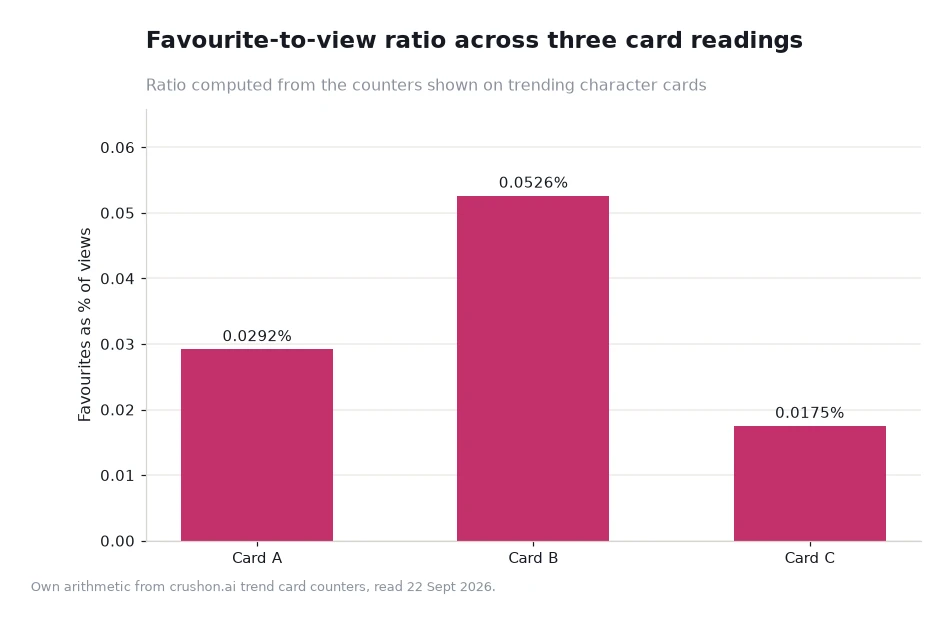
An upgrade decision made during a good session is not a decision, it is an impulse with supporting evidence attached. Crushon publishes its own plan pages, and no figures from them are quoted here, because the signal that matters on a Porn Chat AI platform is behavioural: how often you return, how long you stay, and whether the sessions still work the way they did a month ago. The counters on a card give the same lesson in miniature — on one dated reading the best card earned 0.0526% favourites per view against 0.0175% for the weakest, a three-fold spread that describes retention rather than quality.

Key takeaways
- Three signals justify a review: sustained frequency, consistent session length, and a shortlist that has stopped growing.
- Signals that do not justify one: a single outstanding evening, a new character, or the fear of missing a weekly refresh.
- Put a number on it first. 25 messages a day is 750 a month; below that, a review rarely changes anything.
- Read the platform's own plan pages when you review, and decide on a fixed date rather than in the moment.
Three signals that genuinely justify a review
The first signal is sustained frequency. Not a heavy week, but a pattern that has held for four to six weeks without effort. A habit that keeps reappearing after busy periods is a settled one, and settled habits are what a paid option is usually about.
The second signal is consistent session length. If your sessions reliably run past the point where you planned to stop, the constraint you are feeling is structural rather than accidental, and it is worth investigating what the platform offers beyond the default.
The third signal is the most reliable and the least discussed: a shortlist that has stopped growing. When weeks pass without adding a new character, you are no longer sampling — you are using the platform, and using it is precisely the condition under which a review makes sense. Until that happens, an upgrade is buying options you have not yet shown any sign of exercising.
Signals that do not justify anything
The counter-list is longer than the list itself, and every entry on it is a common trigger for decisions people later describe as premature.
| Signal | What it actually indicates | Better response |
|---|---|---|
| One outstanding session | A good evening, not a pattern | Log it and wait 30 days before acting |
| A new character you like | Novelty, which fades predictably | Run two more sessions with it first |
| A busy week | A temporary spike, often seasonal | Compare with the previous three weeks |
| A weekly refresh you keep checking | Browsing, not deep usage | Set a ten-minute limit on the list instead |
| A friend recommending it | Their usage pattern, not yours | Measure your own month before deciding |
| Feeling you are missing out | Exactly what a review is designed to filter out | Delay the decision and re-read your monthly note |
Every row on that table has the same remedy, and the remedy is a delay. Nothing in a chat platform is scarce enough to require an immediate decision, which means a 30-day rule costs you nothing and removes nearly all of the errors.
Worked example: two numbers, one decision
Take the ratio reading first, because it demonstrates the difference between attention and retention. A card showing 4.7K favourites against 18.2M views reads 4,700 / 18,200,000 = 0.0258%. Two more readings on the same chart sit at 0.0292% and 0.0175%. Divide the top by the bottom: 0.0526 / 0.0175 = 3.0. The three cards are all popular and none of them is being ignored, yet the best earns three favourites per view for every one the weakest earns.
Now apply the same style of thinking to your own usage rather than to a card. Assume a 30-day month and no missed days. At 6 messages a day the month is 180 messages, at 25 a day it is 750, and at 80 a day it is 2,400. Divide by four and the weekly figures are about 45, 190 and 600 messages, which is far easier to compare with the hours you actually have available.
Put the two calculations together and the decision rule writes itself: a review is justified when usage has held above your own threshold for two consecutive months and the shortlist has stopped growing. Both conditions are arithmetic on your own record, and neither depends on how a session felt. The volumes and the time assumptions here are illustrative, built by the author rather than taken from platform data, and no figures from the platform's plan pages are quoted.
Reviewing properly, once
When the conditions are met, do the review in one sitting and on a weekday. Read the platform's own plan pages directly, since they carry the specifics and they are the only current source; the unlimited plan page is the place to start. Then compare what is offered against the usage you recorded, not against what you hope your usage will become.
Keep the frame narrow. The question is whether the pattern you already have would work better with something extra, and the answer is often no for the first six months. Plenty of readers who arrive via a search for porn ai chat options find that the limiting factor was never the platform but the session design: a stated premise, a shortlist drawn from descriptions, and sessions that end deliberately rather than by exhaustion.
One structural point about the label, since it comes up in every such decision: unfiltered describes how the catalogue is labelled, not a promise that nothing is restricted. The platform's content and community guidelines still apply, and some limitations follow from them. A review is about whether your own habit would improve, and that is a narrower question than the marketing on any page.
Frequently asked questions
How long should a habit run before I consider an upgrade?
Two months of steady use is a reasonable bar: long enough for the pattern to survive a busy week, short enough that you are not waiting indefinitely for information you already have.
What is the strongest single trigger?
A shortlist that has stopped growing. It shows you have finished sampling and started using, which is the state in which any extra capability would actually be exercised.
Does a popular character mean I should pay for more of them?
No. A three-fold spread in the favourite-to-view ratio across the leading cards shows that popularity describes the crowd's behaviour, and the crowd's behaviour is not evidence about your own.
Where should I read the plan details?
On the platform's own pages, at the moment of the review. No figures are quoted in this article, because any summary would be stale and a stale summary is worse than none.
Let the schedule decide, not the session
Write two conditions on a note — a usage threshold and a stalled shortlist — and check them on the first weekday of each month. If both hold twice running, do the review properly.
If they do not, close the note and get on with the session. That is the whole discipline, and it takes about ninety seconds a month.
Data and sources: favourite and view counters shown on the trending cards, plus the platform's catalogue, plan and compliance pages, all read from Crushon.AI on 22 Sept 2026[1]. Ratios are the author's arithmetic on those displayed counters; message volumes are illustrative. Content intended for readers aged 18 and over.