RS485 Motion Control for Small Mobile Robot Bases
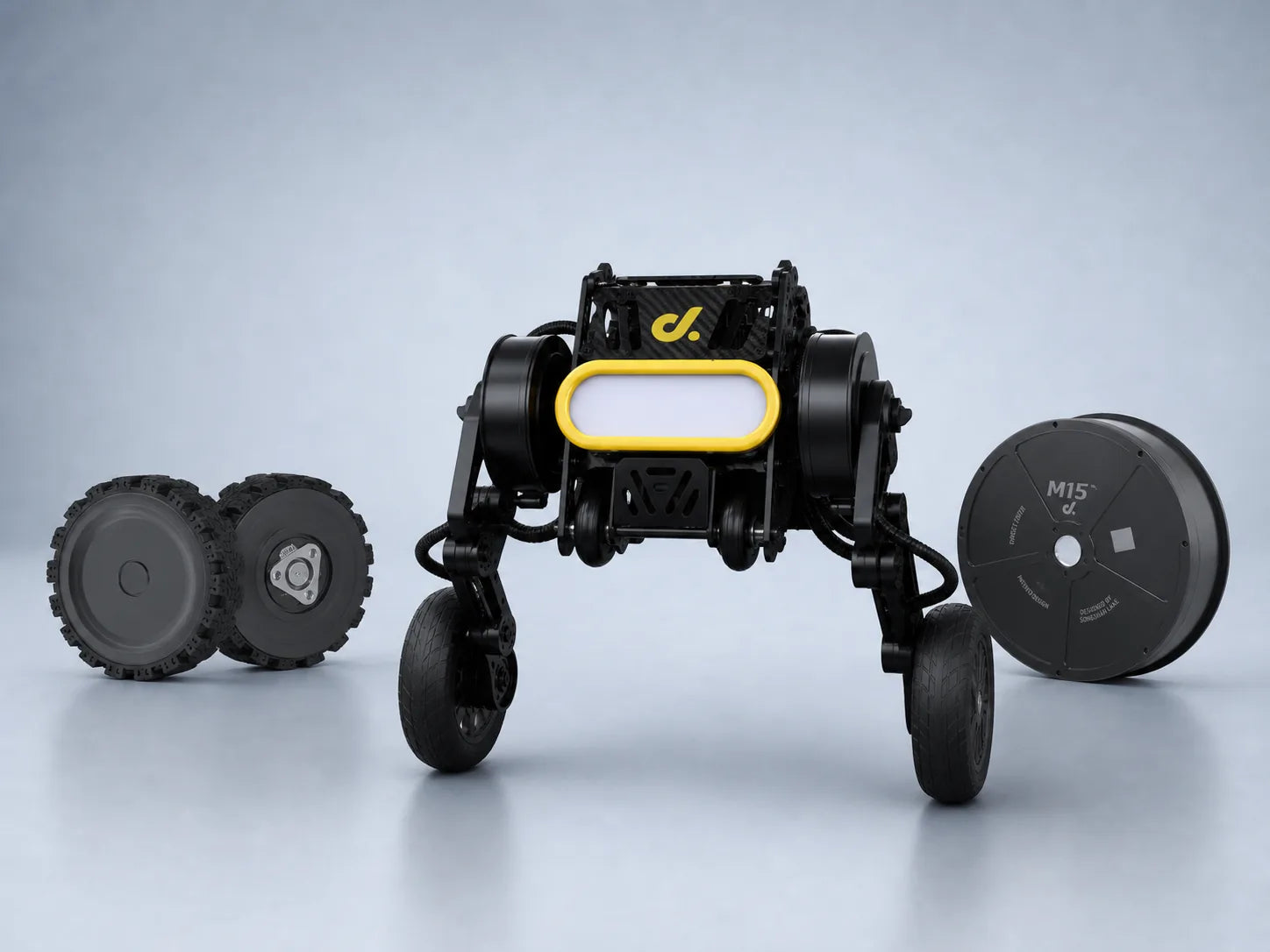
RS485 motion control systems provide a practical communication method for small mobile robot bases by combining reliable differential signaling, multi-device networking, and low-cost hardware. A typical robot platform using RS485 can achieve stable wheel synchronization with update rates above 50–100 Hz, while maintaining communication reliability in electrically noisy environments. The technology is widely applied in indoor autonomous robots, inspection platforms, and service robot wheel motors systems where accurate speed control and compact integration are required.
Small mobile robot bases usually depend on coordinated control between motors, encoders, and embedded controllers. A differential-drive robot, for example, changes direction by adjusting the speed difference between the left and right wheels. If both wheels rotate at the same speed, the robot moves straight; if one wheel slows down, the platform turns. A typical two-wheel mobile base uses two independent motor controllers connected through an RS485 bus, allowing the main processor to send velocity commands and receive feedback data from each motor.
“A stable communication link allows the motor controller to focus on precise regulation instead of compensating for inconsistent data transmission.”
RS485 was introduced as an industrial communication standard in 1983 and remains widely used in automation systems because it supports long-distance communication and strong noise resistance. Unlike single-ended UART signals, RS485 uses differential voltage transmission, where two wires carry opposite signals. External electrical interference affects both wires similarly, allowing the receiver to remove much of the noise during signal processing.
The physical characteristics of RS485 make it suitable for mobile robot applications. A standard RS485 network can support up to 32 unit loads on one bus, although modern transceiver designs can allow more nodes. Transmission distances can reach approximately 1200 meters under suitable conditions, while small robots usually operate within 1–10 meters of cable length. This extra margin improves reliability when motors generate electromagnetic interference.
The communication process in a robot base normally follows a master-slave structure. The main controller sends commands, while motor drivers respond with feedback information. A common frame contains address information, control commands, speed targets, encoder position, current measurements, and error codes.
| Data Item | Typical Function |
|---|---|
| Address | Selects individual motor nodes |
| Command ID | Defines movement or configuration request |
| Speed Target | Controls wheel rotation speed |
| Encoder Feedback | Measures actual wheel movement |
| Current Data | Monitors motor load condition |
| CRC Verification | Checks communication accuracy |
For example, a robot moving at 0.8 m/s may require continuous adjustment of wheel speed because floor conditions, battery voltage, and mechanical friction change over time. Encoder feedback allows the controller to compare target speed with actual speed and update motor output. Many compact mobile robots operate with control cycles between 50 Hz and 200 Hz, depending on processor capability and application requirements.
The accuracy of motion control depends heavily on the relationship between RS485 communication and closed-loop motor regulation. Most small robot bases use PID control algorithms inside motor drivers. The proportional component responds to current speed differences, the integral component corrects long-term deviation, and the derivative component improves response during acceleration or braking.
A robot traveling on a smooth indoor surface may maintain speed errors below 5% when encoder feedback and motor control are properly configured. Without feedback, motor speed can change significantly because of wheel wear, payload changes, or surface friction. For autonomous robots carrying sensors or navigation equipment, these small errors accumulate over distance and affect positioning accuracy.
The motor controller design also influences the performance of RS485-based systems. Modern compact motor modules integrate communication interfaces, current sensing circuits, encoder processing, and protection functions in one unit. Some direct-drive motor solutions, such as those used for compact robotic platforms, combine high torque density with integrated control electronics. More information about this type of motor architecture can be found through M06 Series direct-drive motor solutions.
Distributed control is another important feature of RS485 robot architectures. Instead of sending raw PWM signals from a central computer, the main processor communicates high-level commands such as velocity or position targets. Each motor controller independently manages current regulation and feedback processing.
A typical distributed mobile robot system includes:
| Component | Main Role |
|---|---|
| Embedded Computer | Navigation and task planning |
| RS485 Network | Data communication between modules |
| Motor Controller | Speed and torque regulation |
| Encoder | Position and velocity measurement |
| Battery System | Power supply management |
This structure reduces wiring complexity and allows additional modules to be added without redesigning the entire platform. For example, a warehouse robot may use separate RS485 nodes for left motor, right motor, lifting mechanism, and auxiliary sensors.
However, RS485 communication requires correct electrical design. Signal reflection can occur when transmission lines are not properly terminated. Industrial systems commonly use 120Ω termination resistors at both ends of the communication bus. Incorrect grounding, excessive cable length, or unsuitable baud rates can increase communication errors.
| Design Parameter | Common Selection |
|---|---|
| Cable Type | Twisted-pair cable |
| Termination Resistance | 120Ω |
| Baud Rate | 9.6–115.2 kbps for many robot bases |
| Network Structure | Linear bus |
| Error Detection | CRC and timeout checking |
The selected baud rate depends on communication distance and required update frequency. A small indoor robot generally does not need extremely high bandwidth because motor commands contain limited data. A 115.2 kbps RS485 link can provide frequent command updates while maintaining stable operation. In comparison, higher-speed interfaces may increase hardware cost and software complexity.
RS485 also needs to be evaluated against other communication methods used in robotics. CAN bus provides message arbitration and strong real-time characteristics, making it common in automotive and industrial systems. Ethernet provides higher bandwidth for cameras and large sensor data. Wireless communication offers flexible installation but can introduce latency caused by interference or network congestion.
For small mobile robot bases, RS485 remains attractive because motor control data volume is relatively small. A robot mainly needs accurate speed commands, encoder feedback, and fault information rather than continuous high-bandwidth transmission. This matches the communication capacity of RS485 systems.
Safety functions are also integrated into many RS485 motor controllers. Overcurrent protection, overheating detection, voltage monitoring, and communication timeout protection prevent abnormal operation. For example, if the controller stops receiving commands for a defined period, the motor driver can automatically reduce output or enter a safe state.
From 2010 onward, the growth of autonomous service robots increased demand for compact motor control platforms. Applications expanded from research robots to commercial cleaning robots, delivery robots, and indoor transportation systems. Many of these platforms require motor controllers that combine small size, low power consumption, and stable communication.
The future development of small mobile robot bases will likely combine RS485 networks with advanced navigation sensors, embedded AI processors, and more integrated motor modules. Although newer communication technologies continue to develop, RS485 remains useful in applications where reliability, simplicity, and cost control are important factors. Its long industrial history since 1983 and continued adoption in automation systems show that a simple communication standard can still support modern robotic platforms.